
 Create Document
 Fill & Customize
 Basic Download
 Adobe PDF
 Microsoft Word
 OpenDocument
State Laws
Probate in Tennessee
Petition for Probate of Will
To begin the probate proceedings, the following documents must be filed with the probate court clerk of the county where the decedent resided[4]:
- Petition
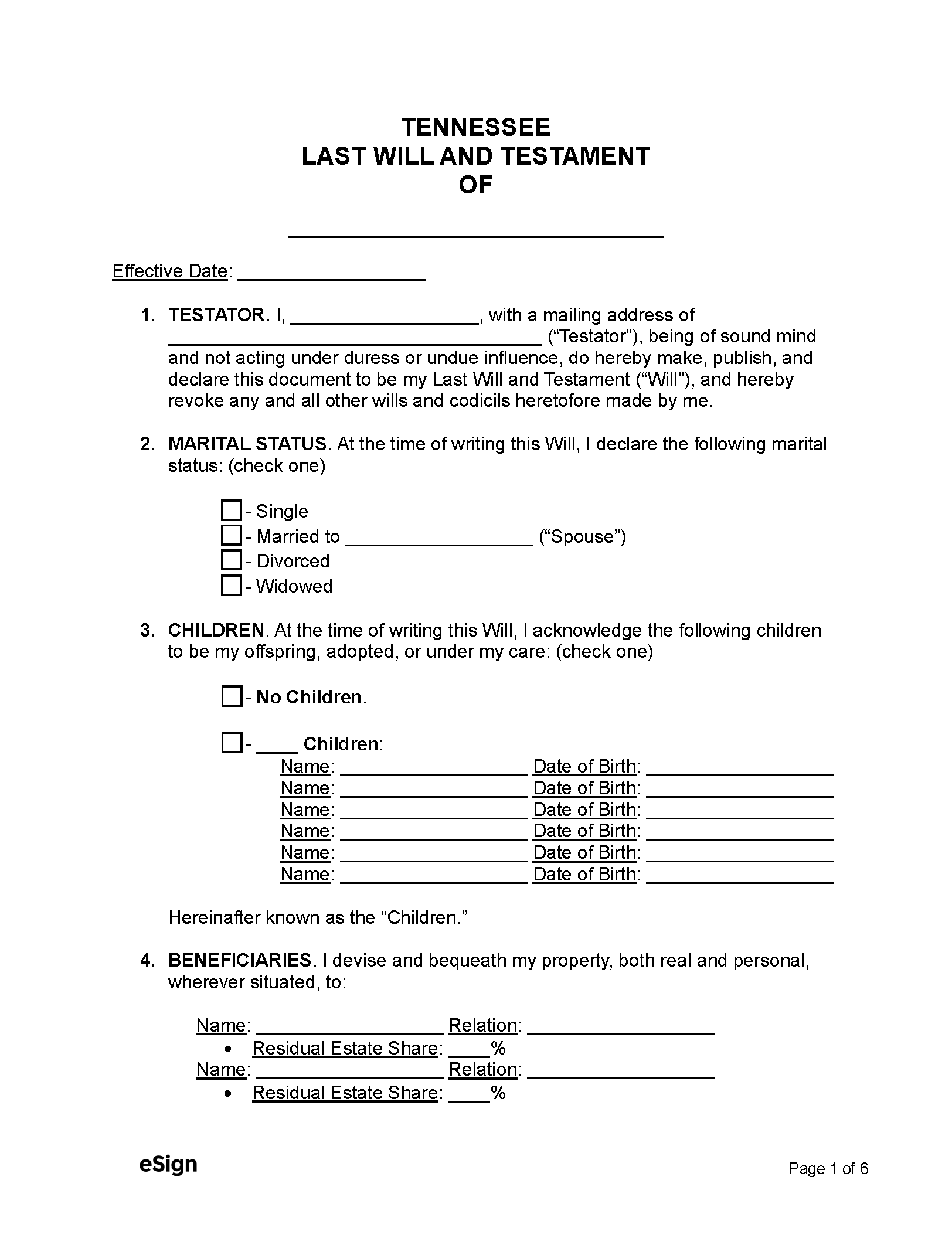
- Last Will and Testament
- Proof of Will
The will’s executor will sign an Oath and receive Letters Testamentary.[5] They must then send the will to beneficiaries, notify creditors of their appointment, and send notice of the testator’s death to the Division of TennCare (if over 55) along with a death certificate and Request and Release Form.[6] Within 60 days of appointment, the executor must file a completed estate Inventory along with affidavits proving the necessary parties were notified.[7]
The executor will have to pay all debts, settle taxes, and distribute assets. Within 15 months of appointment, they must file either a Detailed Final Accounting, or a Statement in Lieu of Final Accounting (signed by distributees) and an Order to Close Without Detailed Accounting.[8]
Small Estates
If the decedent’s personal property is valued at $50,000 or less, the assets may be distributed via Affidavit for Small Estate Limited Letter of Authority rather than full probate.[9]
Sources
- § 32-1-102
- § 32-1-104(a)
- § 32-1-201
- §§ 32-2-101, 32-2-104, Tennessee Probate Guide pg. 2
- § 30-1-111(b)(1)(a)
- §§ 30-2-301(b)(1)(A), 30-2-306, 71-5-116(d)(1)(B) & (D)
- Shelby County Probate Court – Rule 14(A)(4), §§ 30-2-301(a), 30-2-301(b)(3) & (5)
- § 30-2-601(b)(1) & (2), 30-2-601(a)(1), Rutherford County – Estate Matters pg. 5
- § 30-4-103(9), 30-4-102(8)